



Walking and running are two of the simplest ways to get moving—but which one is actually better for you?
The answer isn’t the same for everyone. Both activities can support cardiovascular fitness, help build an active lifestyle, and contribute to overall health. The better choice depends on your fitness level, goals, available time, preferences, and how your body responds to exercise.
So, should you lace up your running shoes or simply go for a walk? Let’s compare the two.
Walking: Simple, Accessible & Effective
Walking is often underestimated because it feels easy. But regular walking can be an excellent way to increase physical activity, especially for people who are beginners, returning to exercise, or simply looking for an activity they can maintain consistently.
A brisk walk can raise your heart rate while putting less impact on your joints than running. You can also easily incorporate walking into your everyday routine—whether that’s taking a morning walk, walking after meals, or choosing to walk instead of driving for short distances.
Why walking is a great choice:
- Easy for most fitness levels
- Lower-impact than running
- Can be done almost anywhere
- Requires little or no equipment
- Can help you stay active consistently
- Great for beginners and active recovery
- Easy to fit into a busy day
🌿 HealthyFitLifestyle Tip:
Don’t underestimate a 20–30 minute brisk walk. Consistency is more important than choosing the most intense workout.
Running: More Intensity in Less Time
Running: More Intensity in Less Time

Running is a higher-intensity activity that can challenge your cardiovascular system more than ordinary walking. Because you’re moving at a faster pace, running can provide a vigorous workout in less time.
For people who enjoy running and have gradually built up their fitness, it can be an effective way to improve cardiovascular endurance and incorporate more vigorous physical activity into their week.
Benefits of running include:
Higher-intensity cardiovascular exercise
Helps improve endurance
Can burn more energy per minute than walking
Can be useful for race or performance goals
Provides a challenging full-body movement pattern
Can improve running-specific fitness over time
However, running isn’t automatically “better.” It also places more stress on your muscles and joints, particularly if you increase your distance or intensity too quickly.
Walking vs. Running: What’s the Difference?
Walking vs. running: a quick comparison
A practical comparison of typical characteristics. The energy-expenditure comparison is relative rather than a universal calorie number.
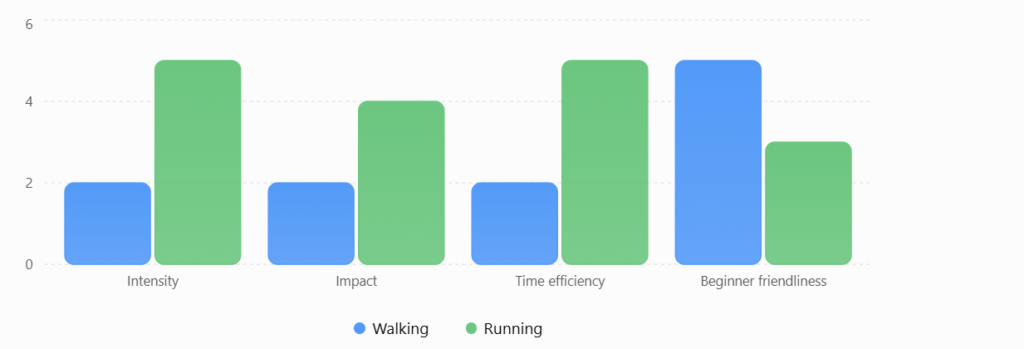
Walking
Lower intensity | Lower impact | Easier to sustain
Running
Higher intensity | Higher impact | Greater cardiovascular challenge
Neither option wins every category. The right choice depends on what you want from your workout.
Which Is Better for Heart Health?
Both walking and running can contribute to cardiovascular health when performed regularly.
For someone who is currently inactive, starting with regular brisk walking may be a practical way to build an exercise habit. As fitness improves, you can gradually introduce jogging or running if you enjoy it and your body tolerates it well.
For people already accustomed to exercise, running can provide vigorous-intensity activity and may help improve cardiovascular fitness efficiently.
The key takeaway:
Moving regularly matters more than choosing the “perfect” activity.
Which Burns More Calories?
Running generally uses more energy per minute than walking because it requires greater intensity.
But that doesn’t mean running is automatically the better choice for managing body weight.
A workout that you enjoy and can perform consistently may be more useful than an intense workout you quickly abandon.
For example:
30 minutes of walking that you do regularly can be more valuable to your lifestyle than 30 minutes of running that you only do occasionally.
Your overall nutrition, activity level, sleep, and other lifestyle factors also matter.
Which is Easier for your Joints?

Walking generally creates less impact than running, making it a comfortable option for many people.
Running involves repeated higher-impact movements, so beginners should avoid suddenly increasing their speed, distance, or frequency.
If you are new to running, a gradual walk-jog progression can be a useful way to build tolerance.
Start small:
Walk → Brisk walk → Walk + jog → Jog → Run
There is no need to rush the process.

Which One Is Better for Weight Management?
This is where many people expect a simple answer—but there isn’t one.
Running typically requires more energy per minute, while walking can be easier to perform for longer periods and more frequently.
Your choice should therefore depend on what you can comfortably and consistently maintain.
Choose walking if:
- You’re new to exercise
- You prefer low-impact movement
- You have limited fitness experience
- You enjoy longer, relaxed sessions
- You want an activity that’s easy to fit into your day
Choose running if:
- You already have a fitness base
- You enjoy higher-intensity exercise
- You want to improve running endurance
- You have specific running goals
- Your body tolerates running well
Don’t Forget the Mental Health Benefits

Exercise isn’t only about calories and physical fitness.
Going outside for a walk can give you time away from screens, work, or everyday responsibilities. Running can also provide a sense of achievement and an opportunity to clear your mind.
For many people, the best activity is simply the one that makes them feel good and want to come back tomorrow.
What If You Don’t Have Much Time?
Running has an advantage here because it allows you to achieve vigorous physical activity in a shorter period.
But you can still make walking part of a busy schedule.
Try:
- Walking during phone calls
- Taking the stairs
- Walking to nearby places
- Taking a short walk during breaks
- Going for a walk after work or dinner
Every bit of movement can help you become more active.
So, Which One Should You Choose?
Here’s the simple answer:
Choose WALKING if you want:
✔ A beginner-friendly activity
✔ Lower-impact movement
✔ Something easy to do regularly
✔ A simple way to become more active
Choose RUNNING if you want:
✔ Higher-intensity exercise
✔ Improved running endurance
✔ A more challenging cardio workout
✔ To train for running events or performance goals
And if you like both?
Do both!
You don’t have to choose one forever.
A weekly routine could include walking on some days, running on others, and rest or other forms of exercise as needed.
HealthyFitLifestyle’s Simple Formula
START SMALL → STAY CONSISTENT → PROGRESS GRADUALLY
You don’t need to run a marathon to become healthier.
You don’t need to walk 10,000 steps every single day.
And you don’t need an expensive gym membership to start moving.
Put on your shoes and start.
Whether that means a 20-minute walk around your neighbourhood or a beginner-friendly jog, the most important step is the one you actually take.
The HealthyFitLifestyle Takeaway
Walking and running can both be valuable forms of exercise. Walking isn’t simply a “lesser” version of running, and running isn’t necessary for everyone.
The best choice is the activity that matches your current fitness level, goals, preferences, and physical comfort—and one you can perform consistently.
Walk more. Run when you’re ready. Keep moving. 🌿
At HealthyFitLifestyle, we believe fitness isn’t about doing the hardest workout. It’s about finding movement that fits your life and making it a habit.
Eat Well. Move Well. Live Well.
Frequently Asked Questions
Is walking better than running?
Neither is universally better. Walking is lower-impact and generally easier to sustain, while running provides higher-intensity exercise in less time.
Is running better for weight loss?
Running generally uses more energy per minute, but sustainable weight management depends on overall diet, physical activity, sleep, and other factors. The best exercise is one you can perform consistently.
Can beginners start running?
Yes, but beginners should start gradually. Alternating walking and jogging can be a practical way to build fitness before progressing to continuous running.
Can walking be enough exercise?
Absolutely. Brisk walking can contribute meaningfully to your weekly physical activity. You can also combine walking with strength training and other forms of exercise.
Should I walk or run every day?
It depends on your fitness level, recovery, and overall exercise routine. You don’t need to perform the same activity every day. Rest and recovery are important, particularly when doing higher-impact activities such as running.